
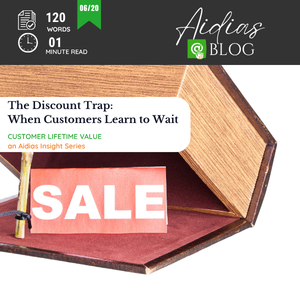
A retailer runs a weekend sale.
Footfall jumps. Sales increase. Everyone is happy.
So the company runs another sale the following month. Again, customers arrive.
Soon, “limited-period offers” appear almost every week.
Then the team notices something uncomfortable.
Customers have stopped buying when there is no promotion.
The business wanted to create urgency. Instead, it taught customers to wait.
Discounts can play a useful role in business. They can encourage someone to try a product for the first time. They can help move inventory, support a seasonal campaign or create excitement around a specific occasion.
The problem begins when the discount becomes the relationship.
The customer stops thinking, “I like buying from them.”
They begin thinking, “I’ll buy when the price drops.”
That difference matters enormously to Customer Lifetime Value.
A customer who stays only while you remain the cheapest does not necessarily have a strong relationship with your organisation.
They have a strong relationship with the deal.
The moment someone offers something cheaper, you give them very little reason to remain.
Customer Lifetime Value grows when customers experience reasons to return that competitors cannot copy overnight simply by changing a number on the price tag.
Maybe your people give better advice.
Maybe dealing with you requires less effort.
Perhaps your service feels more dependable.
Maybe you remember what customers actually need.
Perhaps they simply trust that when something goes wrong, your organisation will not disappear.
These things create value without continuously reducing what the customer pays.
Think about the businesses you personally keep returning to.
They are probably not always the cheapest.
Sometimes you return because the experience feels familiar.
Sometimes someone knows you.
Sometimes dealing with them simply feels easier.
And sometimes you are willing to pay a little more because you trust them.
That sentence—“I may find it cheaper elsewhere, but I prefer dealing with them”—is enormously valuable.
It tells us that the relationship has moved beyond price.
Key Takeaway: Use discounts to open the door. Build enough value so customers do not need another discount to walk through it again.
But where does that deeper value often come from?
Interestingly, customers may forget many details about an interaction.
Yet one thing frequently stays with them.
How the experience made them feel.
That is Blog 7: Customers Forget Details, but Remember the Feeling.