
I learnt a key lesson in early 2020 when my son and I shifted to Nairobi to join my husband. My son, all of 9 years back then, became close friends with a 5 year old Chinese boy, Danny. Danny loved my boy and would call him Kho Kho (Chinese for brother). My son, Rishij, expectedly, knew not a word of Chinese, while Danny, another recent immigrant to Kenya, knew only his mother tongue.
We would often call Danny over to our apartment and I would watch in sheer astonishment how the two children would not just play, but issue commands in sign language, share books, pull jokes, dance to a song and roll with laughter. Of course in the process, each picked up a few words of the other’s language. Danny would smartly walk upto me and pull my sleeves if he had to ask for water or perhaps some interesting tidbit. It was easy. I would show him options till he would gift me his endearing ear to ear grin with eyes closed. Children love to be spoken to, they feel belonged. I would chatter off in Bengali and Danny would listen to me in rapt attention and respond. Aahh was that fun! Danny’s family shifted back to their homeland and we still miss him so much! The communication between Rishij and Danny is my definition of what I would call simple, spontaneous and yes, so effective.
Language as in spoken words, is so trivial, isn’t it, bordering on being utterly inconsequential. Why is it that we as adults leave behind this basic trait as we grow older and step into the hall of corporate wisdom? What can be easily communicated is more often than not, written down, mailed, presented in the savvy digitized versions. Not underplaying the importance of any of these, I believe the key essence often goes glaringly missing. Have we understood each other? Am I therefore making the right inferences which I am expected to make? More importantly, do I even care to be understood?
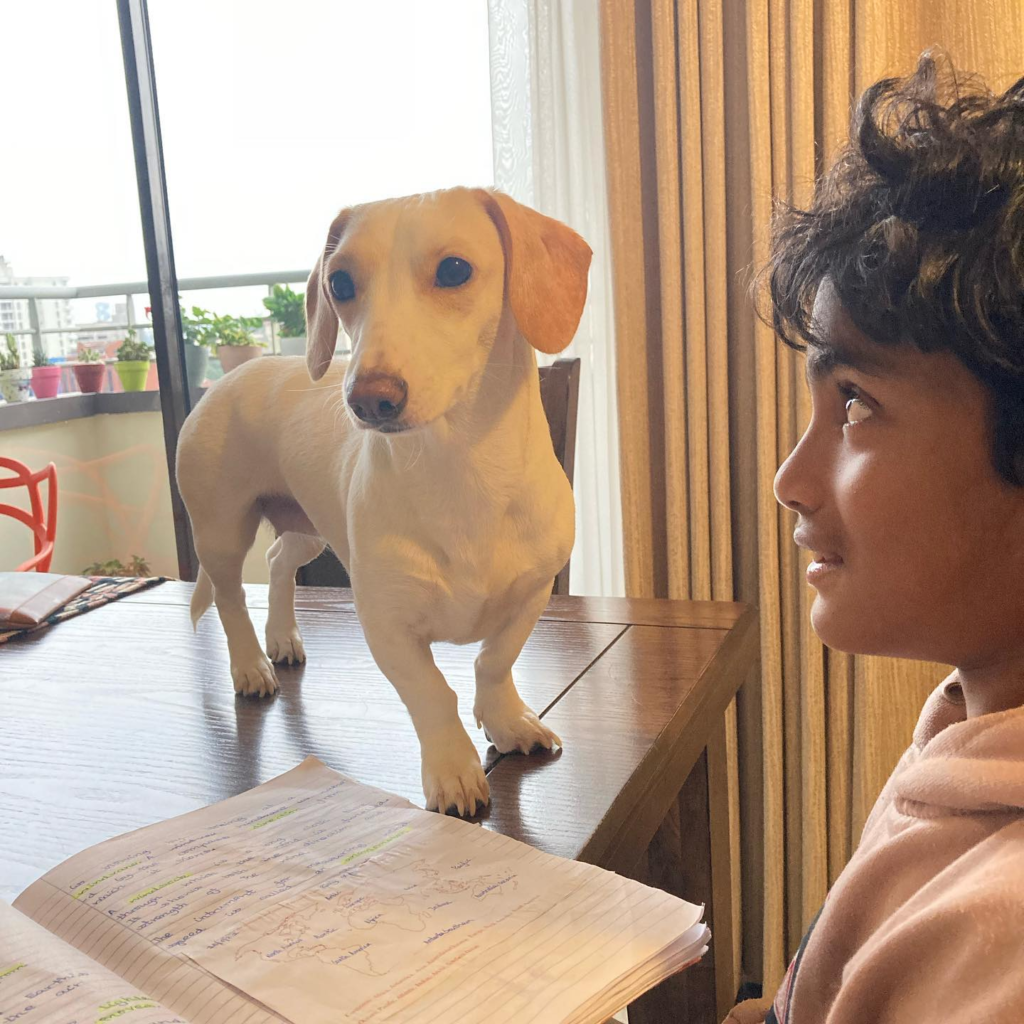
Born into a family of dog lovers, I have two pets at home. Simple emotions as joy, a questioning look requiring clarification, hunger, suspicion, jealousy, mischief, calling for a belly rub, wanting to be picked up for a cajole and a lick and a hundred other needs are communicated so effectively by them to us humans. There is never an iota of doubt of what they wish to say. Dog lovers would know this…when we choose to ignore their “words”, we are often responded to with a cry, followed by a tough reprimand! Our pets and we communicate to perfection, we understand each other completely and there is therefore zero distortion in our human-dog relationship.
Can we not question the WHY NOT behind certain human attributes? The key reason for internal disputes is often an innate inability and lack of willingness to try and establish a robust channel of communication. We tend to write that politically correct e-mail, subtly state our dispute point in slide 6 of our elaborate presentation, mention our pain point across the table with a smile, nicely garbed in decorated English. And we are pleased. We have, after all, said it, haven’t we?
Cut to the scene in the playground of a Bengali boy rattling off the rules of the game to a Chinese kid, who in turn agrees or disagrees with conviction. My Cookie and Chiki, with those innocent eyes giving me a scolding when for a good one minute, I refuse to pick them and place them on my lap. The need to communicate is as archaic as Adam and Eve. Only if we kept things simple and our intentions pure…